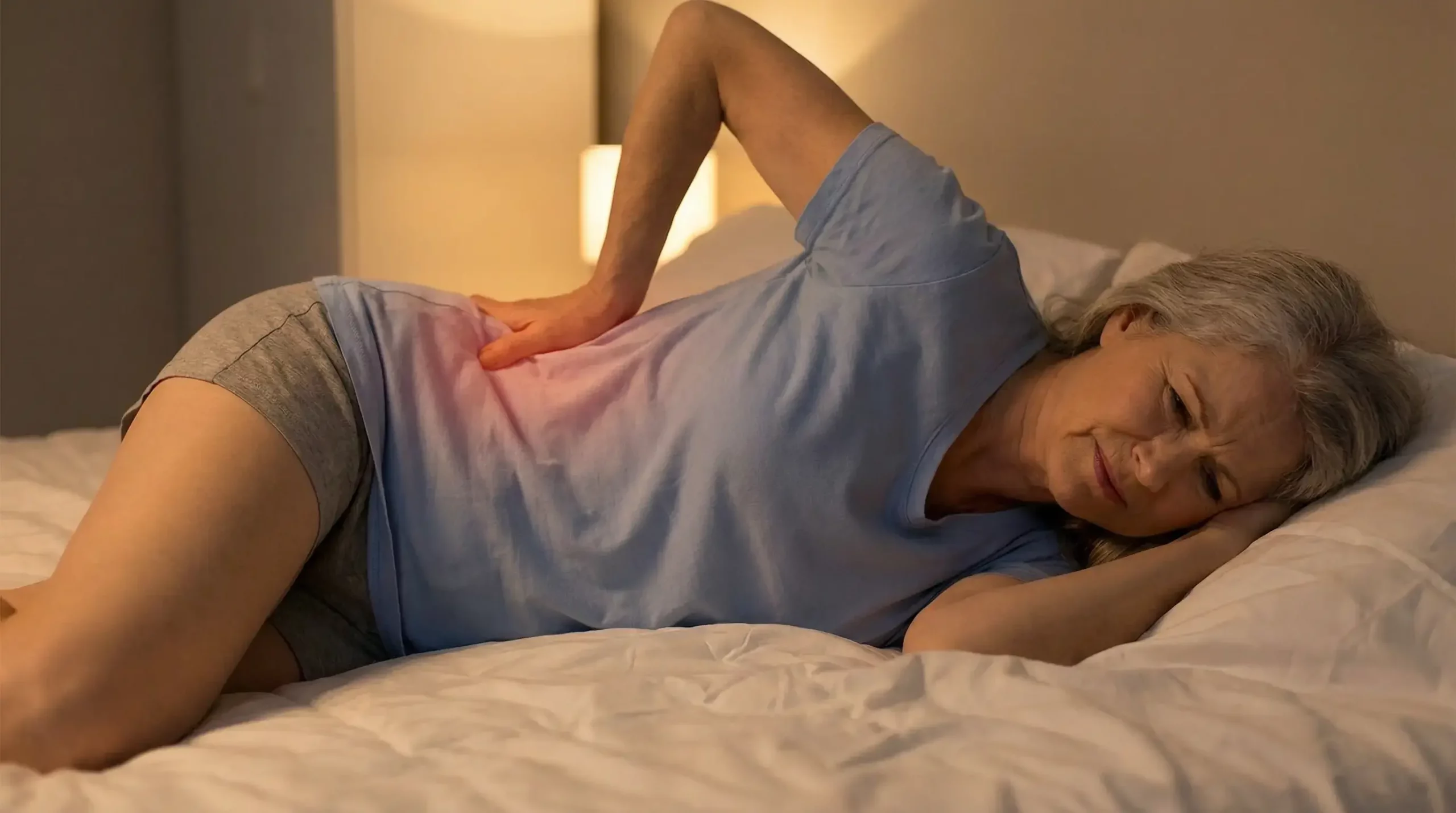
I was 52 years old, lying on my bathroom floor at 2 a.m., because it was the only place in the house that felt cool enough and flat enough to make the burning in my leg stop.
Not my back. My leg. A hot, electric line that ran from my lower back, through my hip, down the back of my thigh, and into my calf — like someone had run a live wire under my skin.
I'd been a side sleeper my whole life. Nobody warns you that the position you've slept in since childhood might start working against you once you hit your 50s.
It started as a dull ache after long days on my feet. Within eight months, it was waking me up four, five times a night. I was popping ibuprofen like breath mints — six, sometimes eight a day — and my stomach was starting to pay for it.
I told myself it would pass. It didn't.
Over the next year and a half, I tried almost everything:
A chiropractor, twice a week, $85 a visit. Temporary relief, gone by the next morning.
A "knee pillow" I found online, promising to keep my hips aligned while I slept. It helped a little on nights I could keep it in place — which wasn't most nights. By 3 a.m. it had always slid out from between my knees.
YouTube stretches. Some helped. One left my foot numb for twenty minutes and scared me enough to stop.
By the end, I'd spent close to $1,400 chasing relief, and I was sleeping worse than when I'd started. I stopped taking my morning walk with my neighbor. I stopped getting down on the floor to play with my grandson, because getting back up wasn't guaranteed anymore.
I remember thinking: I am 52. This is not supposed to be my life yet.
What changed things wasn't a new stretch or a new pillow. It was a conversation with a physical therapist a friend recommended, who said something I hadn't heard from anyone else treating me.
She explained that deep, uninterrupted sleep is when your body does the majority of its overnight tissue repair and inflammation regulation. Sciatica patients tend to get less of it — the pain itself keeps waking them up, which starves the repair process, which keeps the nerve irritated, which causes more pain. A loop.
I went home and started reading. Harvard Health puts lifetime sciatica risk at up to 40% of the population. The Sleep Foundation has reported that a majority of sciatica patients say it significantly disrupts their sleep. And research into fourth- and fifth-decade adults — that's their clinical way of saying "people in their 40s and 50s" — consistently shows this is when incidence peaks.
The pillow had been trying to fix my position. Nobody had been trying to fix what happens to my body during the hours I'm actually asleep.
That search is what led me to grounding — also called earthing.
The idea sounds strange the first time you hear it, so I'll explain it the way it was explained to me. For most of human history, people were in near-constant physical contact with the earth — bare feet on soil, sand, grass. The earth's surface carries a mild, constant supply of free electrons. Physical contact with it — barefoot, skin-to-ground — allows those electrons to transfer into the body.
Modern life put rubber-soled shoes, insulated flooring, and elevated beds between us and that contact, essentially all day, every day.
Researchers studying grounding have focused on what happens when that contact is restored — specifically overnight, since that's the longest single stretch most of us spend in one place. The proposed mechanism is that the electrons act as antioxidants, helping neutralize free radicals and calm the inflammatory response, while also having a measurable calming effect on the nervous system — lower cortisol, a shift out of “fight or flight,” and, as a result, deeper, less interrupted sleep.
None of that fixes spinal alignment. It's not a competing claim to what a chiropractor or a knee pillow does. It's addressing the other half of the equation my physical therapist described — the inflammation and sleep-quality side of a sciatica flare, not the mechanical side.
That's the part that made sense to me: it wasn't trying to replace anything I was already doing. It was trying to help my body do more overnight repair while it did it.
